

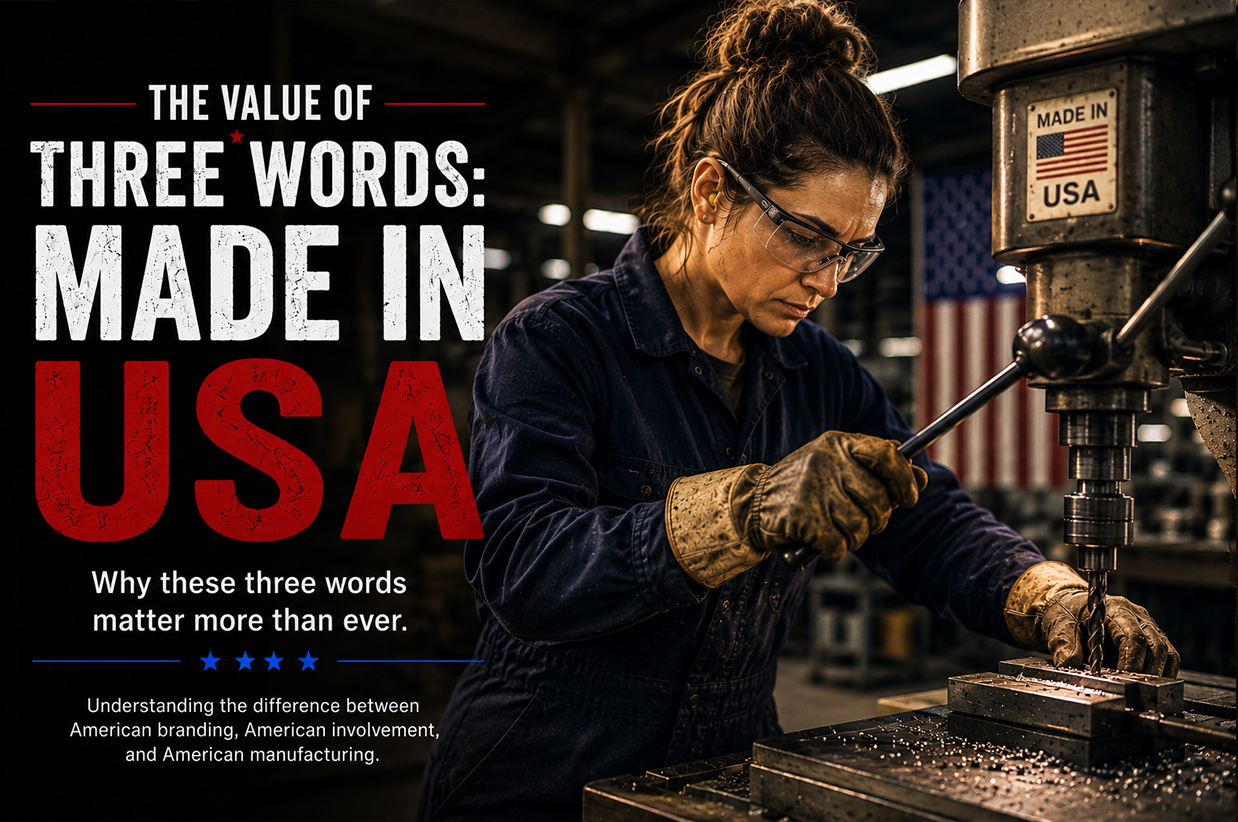
The Value of Three Words: "Made in USA"
There may be no three words in American manufacturing more valuable than "Made in USA."
Those three words influence purchasing decisions every day. For some consumers, they represent quality and craftsmanship. For others, they reflect a desire to support American workers, strengthen domestic manufacturing, and invest in communities across the country. Whatever the motivation, one thing is clear: Made in USA has become one of the most trusted claims a manufacturer can place on a product.
When consumers value something, manufacturers notice.
That's one reason American-sounding language has become increasingly common throughout the marketplace.
Walk through a retail store, browse an online marketplace, or flip through a product catalog and you'll quickly find products described as Designed in USA, Engineered in America, Printed in USA, or Ships from USA. Companies proudly highlight that they're American-owned, family-owned, headquartered in the United States, or have been serving customers for decades.
Most of those statements are accurate.
Many represent significant investments in American jobs, facilities, and innovation.
Yet they often leave consumers believing they've learned something they haven't.
The average shopper usually isn't trying to find out where a product was designed or where customer service answers the phone. Most are trying to answer a much simpler question.
Was this product actually made in the United States?
That question has become more difficult to answer because manufacturing itself has changed.
A generation ago, many products were designed, manufactured, packaged, and shipped from the same factory. Today, a single product may pass through multiple companies, suppliers, and countries before it reaches a consumer.
Take something as ordinary as a coffee maker.
Its designers may work in Oregon. Engineers may spend years developing its electronics in Michigan. The packaging could be printed in Wisconsin. Orders might be fulfilled from a distribution center in Texas, while customer service operates from North Carolina.
Every one of those facts reflects real American jobs.
Every one represents real investment in the United States.
Yet the coffee maker itself may have been manufactured somewhere else entirely.
There is nothing inherently misleading about that story. It reflects the reality of modern manufacturing. Companies naturally want consumers to know about the work they perform in the United States because those contributions are meaningful. Engineering, design, research, packaging, logistics, distribution, and customer support all create American jobs and add value to the finished product.
The challenge is that consumers are often listening for something different.
When shoppers see an American flag beside the words "Designed in USA," it's easy to assume the product was manufactured here. When a website proudly says "Ships from USA," many people naturally associate that statement with American production rather than American fulfillment.
Sometimes those assumptions happen to be correct. Sometimes they don't.
The important point is that these statements describe different parts of a product's journey.
Design tells one story.Engineering tells another.Manufacturing tells another. Packaging and distribution tell yet another. They're all important, but they're not interchangeable.
That distinction is one reason the phrase "Made in USA" carries so much weight. Unlike many other marketing statements, it is fundamentally a manufacturing claim. It answers a different question than where a product was designed, packaged, or shipped.
That value has also encouraged companies to communicate the American parts of their story whenever they can.
"The phrase 'Made in USA' has become incredibly valuable because consumers trust it," says Brad Winnings, COO and Co-Founder of MadeInUSA.com. "That trust wasn't built through marketing alone—it was earned over generations by American manufacturers. That's why it's so important to distinguish between American branding, American involvement, and American manufacturing. They all have value, but they don't all mean the same thing."
That distinction is becoming increasingly important as consumers make more intentional purchasing decisions.
Someone trying to support American manufacturing isn't necessarily looking for the lowest price or the fastest delivery. They're trying to support factories, skilled trades, domestic suppliers, and the communities built around them.
That doesn't diminish the importance of American design, engineering, or innovation. Quite the opposite.
Those contributions deserve recognition because they represent real talent and real investment.
But they tell a different story than manufacturing.
Federal standards recognize that difference. An unqualified Made in USA claim carries a higher standard than simply describing where a product was designed, engineered, packaged, or distributed. Other statements—such as Assembled in USA or Made in USA with Imported Components—also have meaning, but they communicate something different about the product's journey.
For consumers, the takeaway isn't to distrust American-sounding labels.
It's to understand them.
Every statement on a package provides another piece of information about a product. Together, those statements tell the story of how it came to market. The more complete that story is, the easier it becomes for consumers to make informed purchasing decisions.
In the end, the value of the phrase "Made in USA" has never been rooted in marketing alone.
It comes from generations of manufacturers who built products that earned consumers' trust.
That's a legacy worth protecting.
And it begins with making sure those three words continue to mean exactly what consumers believe they mean.