

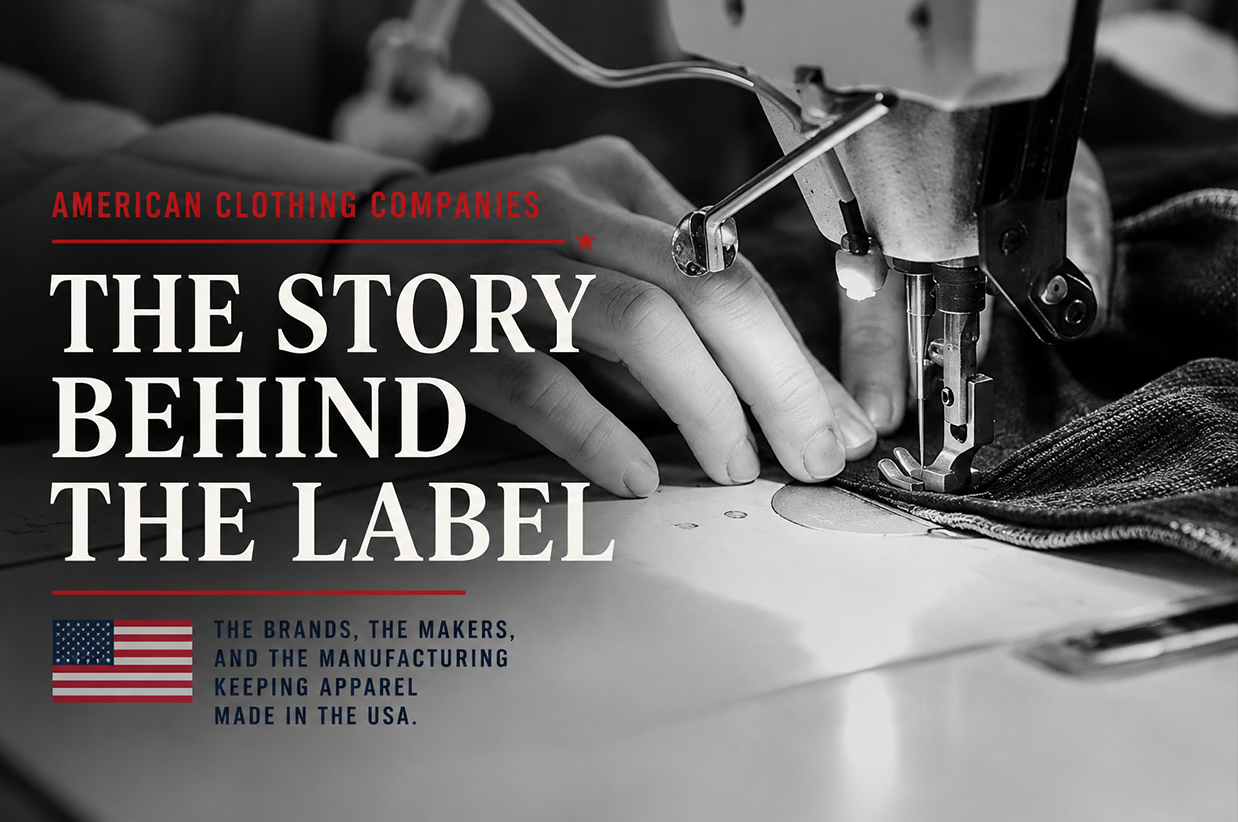
American Clothing Companies: The Story Behind the Label
By: Brad Winnings | MadeInUSA.com
July 8th 2026
There was a time when nobody searched for American clothing companies.
They didn't have to.
A man walking into a hardware store for a work shirt wasn't wondering where it had been sewn. A mother buying jeans for her children didn't stop to read the label inside the waistband. A soldier purchasing a wool coat, a mechanic replacing worn-out coveralls, or a family shopping for school clothes rarely gave a second thought to the garment's country of origin.
For much of the twentieth century, the answer was already understood.
It was made here.
American cotton was transformed into fabric in American textile mills. That fabric traveled to factories where skilled hands cut patterns, stitched seams, attached buttons, inspected finished garments, and packed boxes destined for stores across the country. Entire communities depended on those factories. In many towns, making clothing wasn't simply a job—it was a way of life. Parents taught children the same trade. Families spent generations working under the same roof. The labels inside those garments represented more than a brand. They represented a manufacturing system that stretched from American farms to American factory floors.
The words "Made in USA" weren't a marketing strategy. They were simply the expectation.
Over time, that expectation quietly disappeared. It didn't happen overnight. There was no single moment when American manufacturing came to an end. Instead, the apparel industry changed one factory, one production line, and one business decision at a time. Beginning in the 1970s and accelerating throughout the following decades, clothing production increasingly moved beyond America's borders. Lower manufacturing costs, advances in global shipping, and expanding international supply chains fundamentally changed the way apparel was produced.
The numbers tell part of the story. Today, the United States imports more than $79 billion worth of apparel each year, making it the world's largest single-country importer of clothing. Domestic apparel manufacturing employment has declined by more than 90 percent from its historical peak. What was once one of America's defining manufacturing industries became one of its most globalized.
Yet statistics can sometimes hide as much as they reveal.
Because despite decades of change, American clothing manufacturing never vanished.
It simply became harder to see.
That may be the greatest misunderstanding surrounding the industry today. Many consumers assume American-made clothing has largely disappeared because they rarely encounter it while shopping. In reality, companies across the country continue designing, cutting, sewing, knitting, dyeing, and finishing apparel every single day. They simply exist in a marketplace where finding them has become increasingly difficult.
Ironically, technology has made that challenge even greater.
Open a search engine and type "American clothing companies." Within seconds you'll receive thousands of results. Heritage brands. Fashion brands. Outdoor brands. Sponsored advertisements. Online marketplaces. Social media recommendations. Articles promising "The Best American Clothing Brands."
It feels like the answer should be simple. Instead, it often becomes more confusing.
That's because search engines answer a different question than the one many consumers are actually asking.
- Search engines identify relevance.
- Consumers are searching for origin.
- Those are not always the same thing.
A company founded in the United States is, without question, an American company. Its headquarters may still be here. Its designers may work here. Its customer service representatives, executives, photographers, and marketing teams may all call America home.
That doesn't automatically mean the clothing was manufactured here.
Likewise, a smaller company with little national recognition may quietly produce every garment in an American factory while receiving only a fraction of the visibility enjoyed by globally recognized brands.
Neither business model is inherently better or worse. But they are fundamentally different.
For consumers who intentionally want to support American manufacturing, understanding that difference has become one of the most important parts of shopping.
The distinction isn't about patriotism alone. It's about transparency.
Knowing whether you're supporting an American business, American manufacturing, or both allows consumers to make informed decisions instead of relying on assumptions created by a familiar logo or a search result.
Fortunately, the story doesn't end with factories moving overseas. In many ways, it begins there.
While much of the apparel industry pursued global production, another group of companies chose a different path. Rather than competing solely on the lowest possible manufacturing cost, they chose to compete on craftsmanship, quality, innovation, and accountability. They accepted that manufacturing in America would rarely be the easiest decision. They simply believed it was the right one for their business.
Royal Apparel is one of those companies.
At a time when much of the apparel industry was expanding international production, Royal Apparel doubled down on domestic manufacturing. Its premium basics—from T-shirts and sweatshirts to fleece apparel and everyday essentials—are manufactured in the United States with an emphasis on ethical production, sustainable practices, and consistent quality. The company's philosophy reflects something larger than the garments themselves. It demonstrates that American manufacturing can still compete by offering transparency, craftsmanship, and products built to last rather than simply competing on price.
American manufacturing, however, is no longer limited to traditional apparel.
One of the industry's most impressive success stories comes from a company whose customers spend more time in the wilderness than they do walking city streets.
FORLOH has built its reputation producing highly technical hunting and outdoor apparel that is manufactured entirely in the United States—from the thread itself to the finished garment. Its products are engineered for demanding environments where performance isn't a luxury but a necessity. Waterproof shells, insulated outerwear, technical layering systems, and advanced hunting apparel prove something many consumers mistakenly assume is no longer possible: some of the world's most advanced performance clothing can still be manufactured in America.
American manufacturing also continues to thrive in businesses built around individuality rather than mass production.
SUEDE KLOTH approaches clothing as an extension of personal identity. Its premium hoodies and graphic apparel are designed, sourced, and manufactured in the United States while offering customers the opportunity to personalize products that reflect who they are. That ability to customize isn't simply a design choice. It represents one of the greatest strengths of domestic manufacturing. Smaller production runs, closer relationships with customers, and greater flexibility allow companies like SUEDE KLOTH to create products that feel personal rather than mass produced.
Perhaps the most inspiring story, however, belongs to companies few people have ever heard of.
Across rural America, family-owned manufacturers continue serving communities that larger brands rarely notice. They aren't trying to become global fashion houses. They simply understand the people they make products for.
TakeATote LLC is one of those companies.
Its camouflage apparel for women and children celebrates a lifestyle built around hunting, fishing, farming, and life outdoors. The company isn't chasing fashion trends or celebrity endorsements. It serves customers who want clothing that reflects their lifestyle, their community, and their values. Businesses like TakeATote remind us that American manufacturing isn't sustained only by large factories or nationally recognized brands. It survives because thousands of entrepreneurs continue believing there is value in making products here at home.
These four companies couldn't be more different. One produces premium everyday apparel. Another engineer's technical outdoor gear. One emphasizes customization and self-expression. Another celebrates rural traditions and outdoor life.
Yet they all share one decision that has become increasingly uncommon.
They chose to manufacture in America.
That choice deserves recognition—not because it makes them better than every other company, but because it demonstrates the diversity and resilience that still exists within American manufacturing.
Perhaps that's the lesson this industry has been trying to teach us all along. American clothing manufacturing isn't what it was fifty years ago.
It isn't supposed to be. Industries evolve. Markets change. Technology advances. Consumer expectations shift. The measure of an industry isn't whether it remains frozen in time.
It's whether it continues adapting without losing the values that made it worth preserving in the first place.
Today, American clothing manufacturing looks different than it did in your grandparents' generation. The factories are fewer. The companies are often smaller. The competition is global.
But the craftsmanship remains. The innovation remains. The entrepreneurial spirit remains.Perhaps most importantly, the people remain.
The next time you search for American clothing companies, look beyond the first page of results. Look beyond the advertising. Look beyond the familiar names.
Ask a simple question. Where was this garment made?
The answer may tell you far more about the product than the logo ever will. Because in today's marketplace, an American company tells you who built the business.
A Made in USA label tells you where the story was made.