

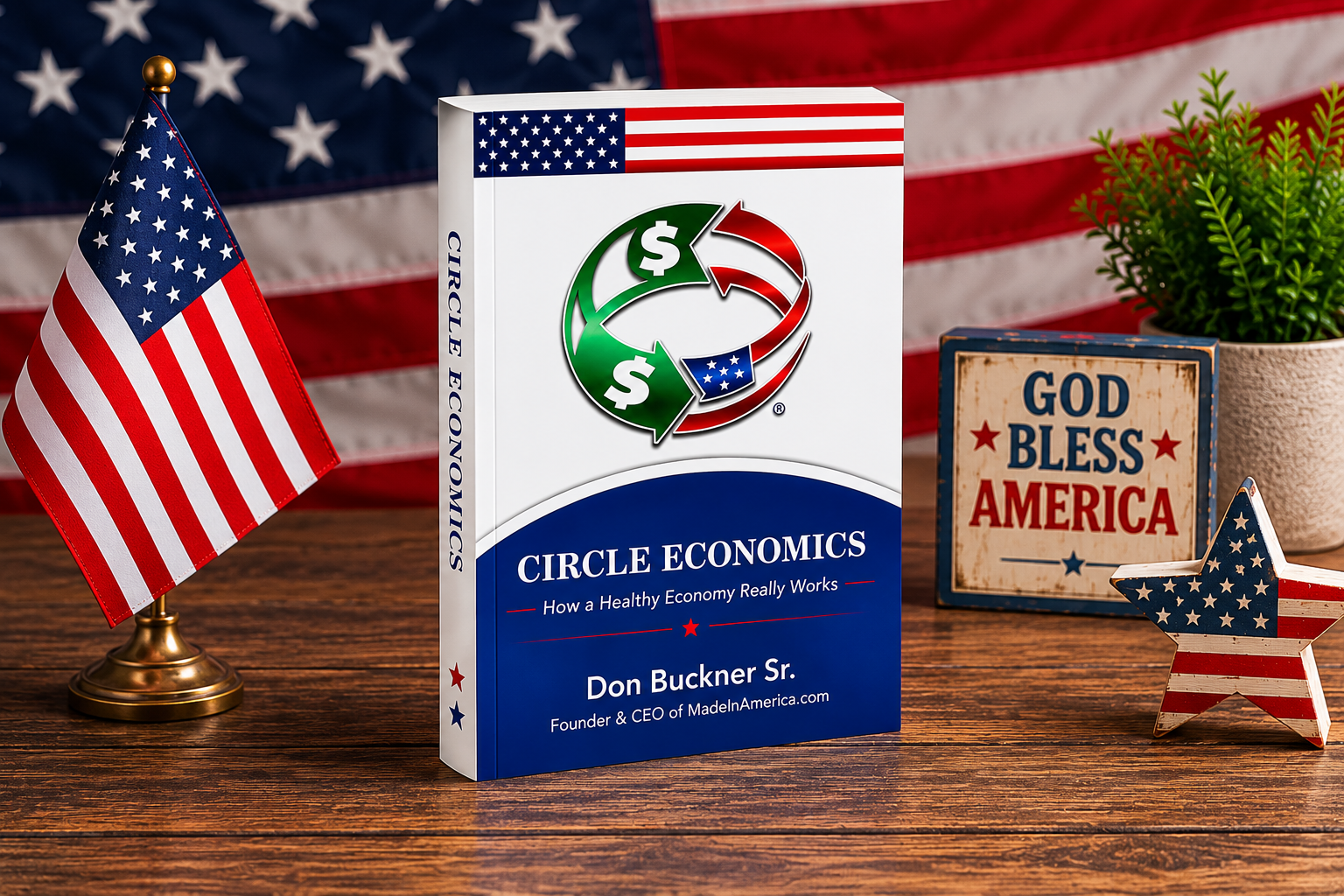
Circle Economics: How a Healthy Economy Really Works — And Why Buying American Matters
What really makes an economy strong?
Is it stock market performance? Government spending? Consumer confidence?
In Circle Economics: How a Healthy Economy Really Works, author Don Buckner Sr. offers a different perspective — one centered around a simple but powerful idea:
Healthy economies grow when money continues circulating through local communities and domestic manufacturing instead of permanently leaving the country.
At its core, Circle Economics explains how wealth is created, retained, and multiplied when consumers support American manufacturing and businesses.
Rather than viewing purchases as isolated transactions, the book encourages readers to see spending as part of a larger economic cycle — one that either strengthens communities or slowly drains wealth away.
What Is Circle Economics?
The philosophy behind Circle Economics is straightforward:
When money stays circulating inside a community or nation, it creates jobs, supports businesses, strengthens manufacturing, and contributes to long-term economic growth.
When money permanently exits the country through imported goods, the economic benefits often leave with it.
The book explores the concept of economic circulation — the idea that every dollar spent domestically can move through multiple layers of the economy:
- Workers earning wages
- Manufacturers producing products
- Suppliers supporting production
- Local businesses providing services
- Families spending income back into communities
- Tax bases supporting infrastructure and investment
Instead of ending after one transaction, money becomes part of a repeating cycle.
In Don Buckner Sr.’s view, this ongoing circulation is one of the foundations of long-term economic health.
Why Manufacturing Matters.
One of the strongest themes in Circle Economics is the importance of domestic manufacturing.
Manufacturing does more than simply create products.
It creates value.
Raw materials and components are transformed into higher-value finished goods while supporting:
- Jobs and wages
- Innovation and productivity
- Supplier networks
- Skilled labor development
- Local investment
- Community stability
According to the book’s philosophy, manufacturing acts as a powerful economic multiplier because every factory job often supports additional jobs throughout the broader economy.
When manufacturing grows, surrounding businesses often grow with it.
Transportation companies, packaging suppliers, service providers, machine shops, logistics operations, retailers, and local communities all benefit from stronger economic circulation.
The Multiplier Effect of Buying American
Every purchase tells a story.
The book argues that when consumers choose American-made products, the economic impact extends beyond the item itself.
Money spent on domestically manufactured goods may continue circulating through:
- American workers
- American manufacturers
- Suppliers and raw material producers
- Shipping and logistics companies
- Local communities and service providers
Instead of immediately leaving the country, spending may generate repeated economic activity.
This concept is often described as a multiplier effect, where one purchase creates additional rounds of economic benefit.
For example:
A consumer purchases an American-made product.
That business pays employees.
Employees buy groceries, fuel, housing, and services.
Businesses hire workers and purchase supplies.
Communities receive tax revenue that supports roads, schools, and local infrastructure.
The cycle continues.
The book frames this as an important distinction between circulating wealth and wealth leakage.
Import Dependency and Economic Retention
Another key theme explored in Circle Economics is import dependency.
The book argues that excessive reliance on imported goods can weaken economic retention over time because money paid for those products may permanently exit domestic circulation.
This doesn’t mean global trade disappears from the conversation.
Rather, the book challenges readers to think critically about where products are made and where economic value ultimately ends up.
Questions explored include:
- Where does my spending go?
- Does this purchase support domestic jobs?
- Does manufacturing happen here?
- Does economic value stay in local communities?
- What industries help strengthen long-term prosperity?
By asking these questions, consumers gain a broader understanding of how everyday purchases influence economic outcomes.
Key Economic Themes in Circle Economics
Money Circulation
Strong economies depend on money continuing to move through workers, businesses, suppliers, and communities.
Domestic Manufacturing
Manufacturing creates value, supports jobs, drives innovation, and strengthens long-term economic resilience.
Economic Retention
Money that remains circulating domestically may contribute to broader economic growth rather than permanently exiting the system.
Local Value Creation
Communities benefit when businesses, suppliers, and workers participate in a healthy economic cycle.
Import Dependency
Heavy dependence on imported goods may reduce domestic economic circulation and long-term wealth retention.
Wealth Growth Through Circulation of Capital
Economic growth becomes stronger when capital continues moving through productive economic activity.
Why This Book Matters Today
In an era of supply chain disruptions, reshoring conversations, rising interest in American manufacturing, and growing concern over economic resilience, Circle Economics offers a practical framework for understanding how economies function at a local and national level.
Rather than focusing solely on abstract economics, the book connects economic theory to everyday decisions — particularly purchasing decisions. It challenges readers to think about a larger question:
What happens after we spend our money?
Does it continue circulating? Or does it permanently leave the communities that depend on it?
Circle Economics: How a Healthy Economy Really Works presents an accessible explanation of economic circulation, manufacturing, and value creation through a lens focused on American industry and long-term prosperity.
Whether you're interested in economics, manufacturing, business, or simply understanding the broader impact of buying American-made products, the book offers a thought-provoking perspective on how healthy economies grow.
At its heart, the message is simple: Strong economies are built when value is created, money circulates, and communities grow together.