

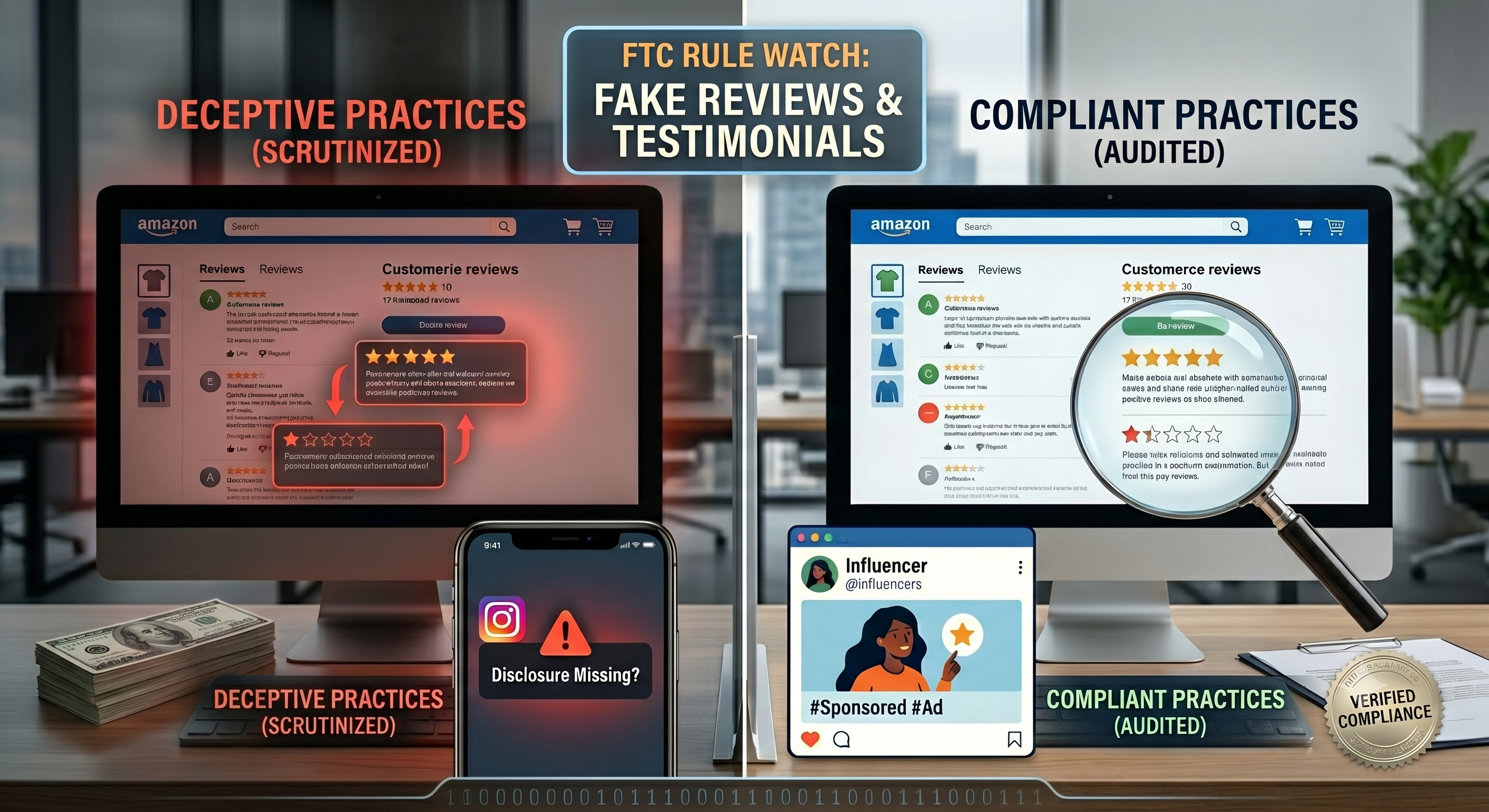
FTC Escalates Enforcement on Fake Reviews and Testimonials in 2026
By: Brad Winnings | MadeInUSA.com
June 1st 2026
The Bottom Line: The Federal Trade Commission (FTC) has officially shifted from its "education phase" to active enforcement of the Consumer Review Fairness Act and the newly implemented Consumer Review Rule. Following a wave of warning letters sent to major companies in late 2025, the FTC is now heavily scrutinizing how businesses solicit, moderate, and display customer feedback in 2026. If your company uses customer testimonials, influencer marketing, or incentivized reviews, it is time to audit your practices to avoid civil penalties that can exceed $53,000 per violation.
What is Changing?
The FTC’s updated Consumer Review Rule strictly prohibits deceptive practices that manipulate consumer perception. While general guidelines have existed for years, the agency is now leveraging its authority to seek immediate financial penalties for the following specific violations:
- Buying Positive (or Negative) Reviews: Offering discounts, gift cards, or other incentives explicitly conditioned on the customer leaving a positive review (or a negative review of a competitor).
- Review "Gatekeeping" or Suppression: Using software or internal policies to filter out and hide negative reviews while only publishing 4- and 5-star ratings on your website.
- Undisclosed Insider Reviews: Allowing employees, managers, or their immediate family members to leave public reviews without clearly and conspicuously disclosing their relationship to the company.
- Fake Social Media Indicators: Purchasing bot-generated followers, likes, or views to misrepresent a brand's influence or a product's popularity.
- Company-Controlled Review Sites: Setting up purportedly "independent" review websites or blogs that are actually owned and controlled by the brand being reviewed.
Who is Affected?
This policy shift impacts almost any B2C or B2B company that leverages digital marketing, but the FTC is specifically targeting:
- E-commerce brands and online retailers.
- Hospitality, travel, and restaurant groups.
- Software-as-a-Service (SaaS) platforms.
- Health, beauty, and wellness consumer goods.
Note: This rule also applies to third-party marketing agencies and PR firms acting on behalf of a brand. Ignorance of an agency's tactics is no longer a viable defense for the parent company.
The Business Impact
This is a classic "medium-impact" regulatory shift. It does not require you to halt operations, overhaul your supply chain, or pay new taxes. However, it completely changes the risk profile of common, aggressive marketing tactics.
Many businesses have historically viewed offering a "10% off coupon for a 5-star review" as a standard growth hack. In 2026, that same tactic is a direct violation of federal law. Because the FTC can levy a $53,088 penalty per individual violation, a single automated email campaign soliciting incentivized positive reviews could theoretically result in millions of dollars in fines if reported by a consumer or competitor.
Strategic Takeaways for Business Owners
- Audit Your Marketing Automation: Review all post-purchase email flows and SMS campaigns. Ensure that if you offer an incentive for a review, it is provided regardless of whether the review is positive or negative.
- Update Employee Social Media Policies: Explicitly state in your employee handbook that staff members must disclose their employment status if they choose to post a review or endorse the company's products online (e.g., using hashtags like #Employee or #CompanyAffiliate).
- Check Your Website's Review Widget: If you host reviews on your own domain, ensure your moderation policy is neutral. You can remove reviews that contain profanity or spam, but you cannot delete a review simply because it expresses negative sentiment about your product.
- Vet Your Influencers: Ensure any paid influencers or affiliates are strictly adhering to FTC disclosure guidelines. Your brand can be held liable for an influencer's failure to disclose a sponsored post.
Legal & Regulatory Analysis (2026 Enforcement Context)
- Arnold & Porter Regulatory Update (Jan 2026): FTC Issues Warning Letters Over Consumer Review Rule: What Marketers Need To Know
- Details the FTC's shift to active enforcement following the late 2025 warning letters sent to 10 companies, confirming the $53,088 civil penalty per violation.
- Benesch Law Insight (April 2026): Five Stars, Zero Tolerance: FTC Turns Up Enforcement Under Consumer Review Rule
- Breaks down how the FTC is demanding immediate corrective actions and audits from businesses regarding sentiment-conditioned incentives and company-controlled review sites.
- Keller and Heckman LLP (Jan 2026): FTC Warns 10 Companies to Comply with the Consumer Review Rule
- Provides further legal analysis on the FTC's focus on e-commerce, hospitality, and influencer marketing, explicitly noting the end of the "education phase" and the beginning of federal lawsuits and penalties.
Disclaimer: The featured image in this article is a conceptual illustration synthesized using AI for editorial purposes. It does not depict real individuals or events.